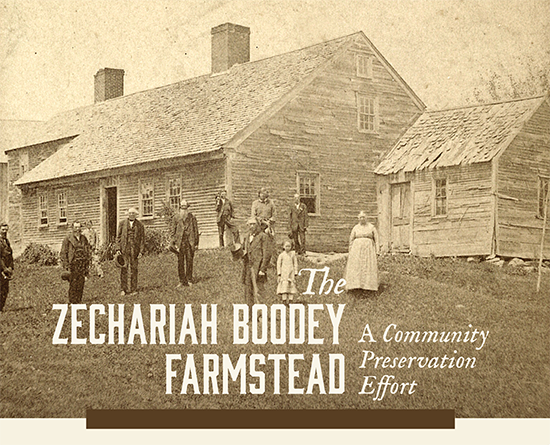
The Zechariah Boodey Farmstead: A Community Preservation Project
By Christine C. Evans, Boodey and Randall Families Descendant
A note from the editor: This article, somewhat unusual for ONE Magazine, traces the ongoing restoration efforts for the Zechariah Boodey Farmstead. The building, located near the Ridge Church in New Durham, New Hampshire, marks the first meeting place for Free Will Baptists in New England.
A Shared Heritage
Zechariah Boodey II was a leading figure among the first settlers in New Durham, New Hampshire, during the community’s founding years. He was the second to bear the name Zechariah in the colonial States. The son of Azariah and Bridget, Zechariah was born in Madbury, New Hampshire, in November 1745. One of nine children, Zechariah married Mary DeMerritt, a member of the DeMerritt family of Madbury, New Hampshire.
The couple settled in the newly incorporated town of New Durham in November 1768, after purchasing 100 acres. It is said Zechariah “felled the wild native forest, cleared up his lands, and built his barn and dwelling house there on.” During the first winter, the Boodeys built a log cabin. In 1773, their son Joseph Boodey (Elder) was born in the log cabin.
In 1769, they constructed a colonial post-and-beam Cape Cod dwelling. The frame consists of heavy timbers, with posts and crossbeams hand-hewn from the forest and interior walls lined with hand-hewn panels. Using fieldstones from the land, the basement stonework was laid in place.
“After hearing Randall preach while visiting acquaintances in New Durham, several of the settlers invited him and his family to move to the town. The following fall, Randall accepted the invitation to become the town’s minister.” Randall and his family moved from Newcastle, New Hampshire, by ox cart to New Durham March 23, 1778, a trip taking three days. Zechariah and his brothers Robert and Joseph were early supporting members of the denomination later called Freewill Baptists, founded by Elder Benjamin Randall.
On June 30, 1780, the covenant of the new denomination was signed in the east room of the Boodey home by the original seven founding members: Elder Benjamin Randall, Robert Boodey (Zechariah’s brother), Nathaniel Buzzell, Joseph Boodey (Zechariah’s brother), Judith Chartel, Margery Boodey (Robert’s wife), and Mary Buzzell (Nathaniel’s wife and Elder Randall’s sister). Zechariah’s home, which served as the meeting place, became known as the birthplace of the Free Will Baptist denomination. Miss Betsey P. Boodey, granddaughter of Zechariah, responded to a reporter’s question about why Elder Benjamin Randall selected the Boodey house to hold his first meetings. She replied, “It was chosen because it was the best house in town and the front room was large.”
Protecting and Preserving
As a direct descendant of both Zechariah Boodey and Elder Benjamin Randall, the historic Boodey Cape Cod house holds a special significance for my family. Seven generations have lived on the original homestead. Many of our ancestors lived, raised families, and made their final resting place on the land.
Efforts to preserve the Cape Cod house began in 2006, when my family donated the Boodey house to the town of New Durham. Plans to disassemble the house were accelerated after a 2008 arson attack.
Community Action and Key Milestones
After accepting the donation of the timber-frame house, the town’s selectboard appointed a committee to develop and implement a plan for the preservation of the historical landmarks and to raise funds by any lawful means.
The Zechariah Boodey Farmstead originated as a historic preservation initiative centered on the 1769 timber-framed colonial Cape Cod style house. It is a national landmark for its architectural style, and for its distinction as the birthplace of the Free Will Baptist denomination. The Mooney/Damon barn is a Yankee-style barn originally constructed in the early 18th century and once owned by the famous author, humorist, and lecturer Bertha Damon. These places are associated with the lives of persons and events significant in our community and nation’s past.
The buildings embody the distinctive characteristics of a type, style, period, and construction method, representing a part of our shared heritage of which we can all be proud. The original property’s footprint included the house, an addition to the west gable of the house, the log cabin attached to the east gable of the house, and a barn. The reassembly and new construction of these buildings will be known as the Zechariah Boodey Farmstead Project.
The project has achieved several milestones over the years. In 2017, while developing a business/marketing plan, the committee learned of significant challenges facing a house museum in the Lakes Region of New Hampshire. This led to a shift in the plan to add this threatened building to the original structures at Boodey Farm.
After the house and barn were dismantled, moved, and stored, timber frame assessments were completed on both structures. A permanent location on town-owned property has been designated for the reassembly and construction of the farmstead, approximately two miles north of the original Boodey family site.
The committee received approvals from local and state regulatory land-use boards and has state-approved septic design. The project has benefited from strong public-private partnerships. One example is the donation of in-kind services to install the septic system and to provide base materials for the site-approved parking lot.
Supporting opportunities for educating our youth and tradesmen has always been a high priority. During the 2018 school year, students from the civil engineering capstone project senior class at the University of New Hampshire completed preliminary designs for the Farmstead project. Their work was used to move forward with the next phase of documentation. Formal architectural drawings were recently completed, enabling the committee to obtain budgetary quotes to determine costs for the reassembly and reconstruction of the buildings.
Since 2021, the project has greatly benefited
from and values its partnership with the Zechariah Boodey Farmstead Collaborative. This federally recognized nonprofit’s mission is “to raise funds to support the reassembly and construction of the historic Zechariah Boodey Farmstead Project and provide a valuable asset and an economic centerpiece for our local community.”
Preserving historic landmarks safeguards our shared heritage.
The Boodey family home once served as a gathering place for brave pioneers who dared to lead in their beliefs during a pivotal time in our nation’s history. These buildings will serve as a gathering spot for future generations, hosting a variety of historical and cultural programs, along with civic, educational, social, or private events and activities for audiences.
The Zechariah Boodey Farmstead Project will continue to attract residents and visitors to our village core. It seeks to enhance community vibrancy and promote support for local businesses, active recreation, retail trade, and cultural experiences.
Preserving the Zechariah Boodey Farmstead is essential. Starting in 2026, the Zechariah Boodey Farmstead Collaborative will share exciting news about fundraising opportunities that could double the impact of contributions for advancing this project.
For more information and to support preservation efforts, visit zbfcnh.org. Online donations are simple. Tap the “Donor Button” at zbfcnh.org, or you can send a check by mail to