It all started with The Hardy Boys Handbook, where Frank and Joe taught me to start a fire with a magnifying glass.
As a curious (and somewhat devious) little guy, I quickly found my grandmother’s powerful magnifier worked like magic. I thought it might be fun to “torch” the fire ants along the edge of the piney woods behind her Florida home. Give them some fire of their own for a change!
The only problem? The ant beds were surrounded by thick pine needles dried by the hot summer sun — perfect kindling. Within minutes, the piney woods were burning, and I found myself surrounded by firemen. Small spark. Big blaze. Disastrous results.
Almost sounds like words.
I’m not sure I recall another time when words hold such power. In this politically-charged, social media-fueled world, a single sentence can get someone fired or bring down a company. Words can tear a family or church apart. They have been weaponized, sharpened, and like poisoned arrows, holding deadly power.
Turns out we humans have a horrible speech impediment — our sin nature. We simply can’t control our mouths (James 3:1-12). James wrote to Jewish Christians scattered across the ancient world by persecution. What principles did James offer to govern our communication as believers?
“Small” words really aren’t small (verses 3-6). Have you ever stopped to consider how small words shape our lives? Yes, no, I do, I don’t, stop, go — all four letters or less, but these miniscule words can alter the entire course of life.
James compared words to a bit, a rudder, and a fire, all small things that make a big difference. Yet all have something in common. Each requires a third party. The horse doesn’t put in its own bit, a ship doesn’t turn its own rudder, and fire doesn’t start itself.
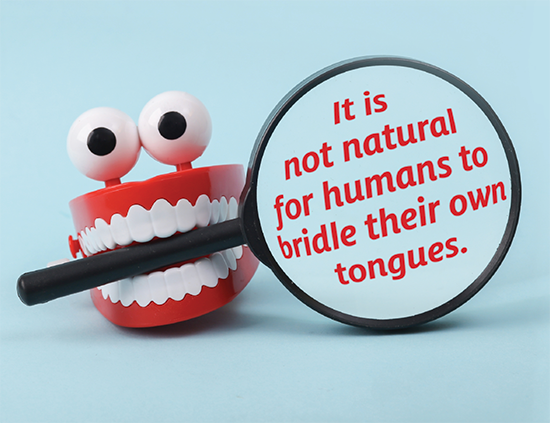
What was James trying to tell us? It is not natural for humans to bridle our own tongues. Only through surrender to the Holy Spirit can our mouths be brought into submission. Aren’t you thankful for His quiet nudge that reminds us to think twice and talk once? That’s essentially what James said in 1:19: Let every man be swift to hear (listen first), slow to speak (think your words through), slow to wrath (don’t react in anger).
Words carry lasting impact (verse 6). “Oh, I’d like to have that back.” The problem is, once words are spoken, they cannot be retracted. Forgiven? Yes. Taken back? No. Verse six reminds us what we say can destroy our lives (defile the whole body) and set our entire life ablaze. I don’t consider it a theological stretch to observe one “life on fire” can spread to others and ultimately cause great damage in the Body of Christ, even across generations. Unguarded speech can become a “world of iniquity” in a few sentences.
Our words should match our lives (verses 8-12). We should speak our faith clearly and live consistently. Our words are an accurate barometer of our relationship with Christ, and so James offered three suggestions:
Acknowledge our inability to control our tongue (verse 8).
Talk to others respectfully, as they are image-bearers of God (verse 9).
Use speech befitting a Christian (verses 9-12):
blessing, not cursing; sweet, not bitter; Spirit-filled, not flesh-driven.
Day by day, hour by hour, our words are writing the book of our lives for others to read. What will today’s chapter say about you?
About the Columnist: Eric K. Thomsen has been the managing editor of ONE Magazine since 2005. He is the worship leader at Bethel FWB Church near Ashland City, Tennessee, where he and his wife Jennifer also teach a college and young career Sunday School class.