In his book The Screwtape Letters, C.S. Lewis painted a vivid picture of spiritual warfare through an ongoing conversation between a head demon (Screwtape) and one of his minions, a demon named Wormwood. The two are working hard to tempt a man, and their conversations about their target are designed by Lewis to help us imagine and understand the opponent’s strategy. Consider one exchange about the lure of the world:
Since the Enemy’s servants have been preaching about “the World” as one of the great standard temptations for two thousand years, this might seem difficult to do. But fortunately, they have said very little about it for the last few decades. In modern Christian writings, though I see much (indeed more than I like) about Mammon, I see few of the old warnings about Worldly Vanities, the Choice of Friends, and the Value of Time.
Here, the demon celebrates that you don’t hear much in Christian circles anymore about worldly vanities, choice of friends, and the value of time. And if these were problems in Lewis’ day, how much more today? The Bible makes it clear that the world — both spiritual and physical — is a dangerous place. The values and practices of this present age are a danger to the Christian’s testimony and faith.
However, the Church is called to be separate from the world. In verse 17 of this passage, both individual Christians and the local church are called to separation. This word is used in other places in the New Testament. For instance, Paul often stated he was separated or set apart to be an apostle. In this passage, the emphasis falls upon our responsibility to be separate from the world.
First, it is important to understand what separation does not mean. We must not separate from relationships with unbelievers. Doing so would cut them off from access to the gospel. Paul wrote about this in 1 Corinthians 5, requesting the congregation to break fellowship with a man in the church who was guilty of immorality. He requested this action in hope the wayward brother would repent of his sin. But Paul also emphasized this did not mean the church should stop interacting with the world at large. Instead, he echoed the principle taught by Jesus: to be in the world but not of the world.
Leading Questions
Paul began this passage with a command not to be “unequally yoked” with unbelievers. Most commentators agree Paul was alluding to the section in Deuteronomy where the Israelites were told not to yoke different types of animals together for plowing. For centuries, this verse has been used to teach — and rightly so — Christians should not marry unbelievers. After all, there’s no greater “yoking” than the bonds of marriage.
However, this principle extends beyond marriage to other relationships. Consider business partnerships. If a Christian starts a business with an unbeliever, it is likely the differing worldview, values, and core beliefs will clash. To emphasize this principle, the Apostle asked a series of rhetorical questions that essentially lead to the same obvious conclusion:
What fellowship hath righteousness with unrighteousness? None!
What communion hath light with darkness? None!
What concord hath Christ with Belial? None!
What part hath he that believeth with an infidel? None!
What agreement hath the temple of God with idols? None!
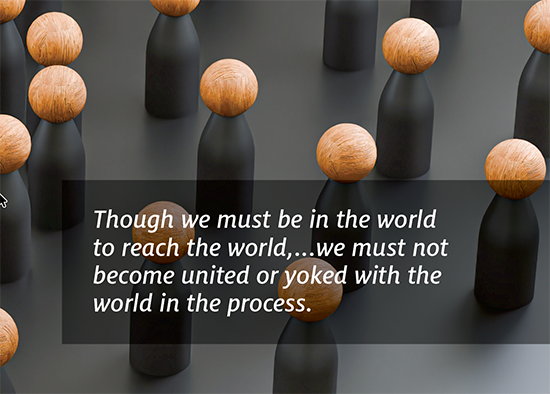
Though we must be in the world to reach the world, Paul makes it clear we must not become united or yoked with the world in the process.
Precious Promises
In verses 16-18, Paul shared “precious promises” from the Old Testament, specifically Isaiah 52, Ezekiel 20, Ezekiel 37, and 2 Samuel 7. God made these covenant promises to Israel, and now they also apply to the new covenant people of God, those in Christ. In this letter, Paul already indicated the promises of God find their yes or amen in Christ. If we are in Christ, we have entered a covenant sealed by the blood of Christ, through which God forgives our sins, shares the gift of the Holy Spirit, and writes His laws on our hearts.
These promises come from God Himself, and He will do what He says. These promises reflect God’s heart for us; He desires to dwell among us, walk with us, draw us close as sons and daughters. They focus on who God is to every believer: our ever-present Father, welcoming us as sons and daughters.
We all grow weary of politicians who say they are going to do this or that, only to get elected and do exactly the opposite. Sure, some are well-intentioned, but good intentions are not the same as following through. Rest assured! God always keeps His promises to us.
Personal Responsibility
These promises bring responsibility. “Wherefore come out from among them, and be ye separate, saith the Lord, and touch not the unclean thing” (verse 17). We must cleanse ourselves. What defiles the flesh and spirit? Moral pollution comes from both outward action and inward attitudes and desires. We are guilty of defiling the flesh and spirit when we go against God’s clearly revealed will in the Bible.
How do we cleanse ourselves? We can only be cleansed by the blood of Christ. The old hymn answers the question simply: “What can wash away my sins? Nothing but the blood of Jesus. What can make me whole again? Nothing but the blood of Jesus.”
Once Christ has cleansed our hearts and souls, we have a responsibility to live with newness of life, to allow the Holy Spirit to work within us and keep on perfecting holiness. This is an ongoing process and will never be completed in this life. From the moment we accept Christ as our Savior, we grow in the grace and knowledge of Jesus, becoming more like Him until the day we die.
During the pandemic, we all got used to washing our hands more frequently. I still carry a small bottle of hand sanitizer in my truck, and it has become a regular habit to use sanitizer after I have been in a public space. While I do not suggest we become obsessed with introspection regarding our Christian lives, we should cleanse ourselves regularly by comparing our lives to the perfect guide of God’s Word and letting His Spirit point out imperfections.
God does not save us to take us out of the world. He leaves us here to reach the world for Christ. And our separated lives — lives reflecting the change Christ makes within — should draw others toward the Savior.
About the Columnist: Dr. Barry Raper pastors Bethel FWB Church near Ashland City, Tennessee, and teaches ministry at Welch College.