The column "Leadership Whiteboard" provides a short visual leadership coaching moment. It introduces and explains a new sketch in each issue, provides leadership coaching for further development, and shares a leadership quote and recommended book.
Leadership Whiteboard | Phrases Leaders Struggle to Say, Part 1
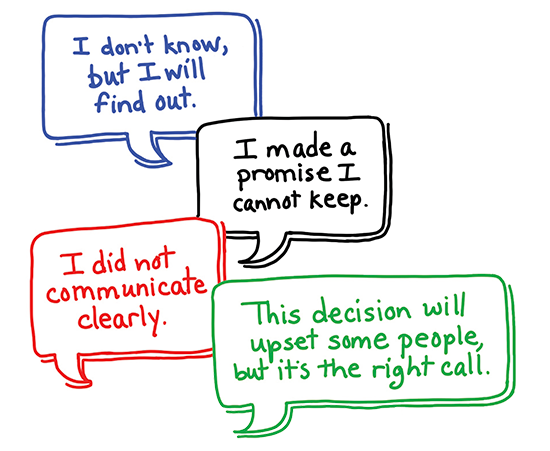
Leaders rarely stumble over strategy; they stumble over the crucial words they cannot bring themselves to say. Over the next five issues, we will explore twenty statements that reveal character, build trust, and foster a strong culture. Each column will feature four challenging phrases and demonstrate how courageous leaders make them an everyday practice. The first four phrases center on courage, clarity, and integrity — core characteristics required when decisions carry weight and consequences.
When a leader says, “I don’t know, but I will find out,” the room feels a surprising shift. People lean in. Though pretending drains trust, admitting uncertainty builds it. The healthiest teams do not follow leaders who claim to have all the answers. They follow leaders who invite others into discovery. Trust deepens when the leader names uncertainty, seeks wisdom, and chooses clarity over posturing. It is a phrase leaders and parents should use more often. This simple confession creates oxygen for honest dialogue.
The statement “I made a promise I cannot keep” expresses a deep level of humility. Many leaders overestimate their capacity or underestimate the cost of a commitment. Admitting a promise cannot be fulfilled requires courage. It also protects team culture from slow erosion. Leadership credibility does not weaken when we name our limits. Credibility is weakened when we pretend we have no limits.
To say, “I did not communicate clearly,” demands a leader who resists the temptation to blame others for confusion. Communication failures rarely belong to the listener; they often belong to the communicator. Small misunderstandings can produce large consequences. Leaders who take responsibility for clarity prevent unnecessary frustration, reduce wasted energy, and create alignment faster. They choose accuracy over assumption, and everyone benefits.
Finally, “This decision will upset some people, but it is the right call,” marks a leader who understands the cost of conviction. Every meaningful decision creates discomfort, and no leader can deliver an outcome where everyone wins or feels at ease. Leaders who avoid disruption eventually compromise their mission. Those who courageously make the call and allow the culture time to adjust will earn more respect in the long run. Strong leaders refuse to trade long-term health for short-term peace. They pursue what is right, not what is popular.
These four phrases point to a single truth: leadership requires honesty before it requires expertise. Leaders who speak truthfully about limitations, broken promises, unclear communication, and difficult decisions build a culture stronger than any strategic plan. Followers often spot a leader’s limits first, and when both sides name the truth, trust grows, and the culture strengthens. When leaders speak with courage, people follow with confidence.