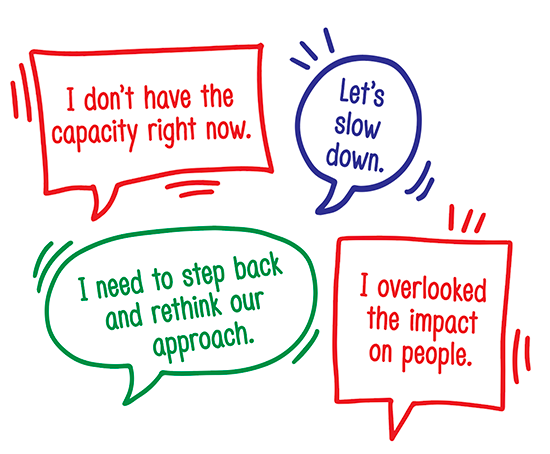
The column "Leadership Whiteboard" provides a short visual leadership coaching moment. It introduces and explains a new sketch in each issue, provides leadership coaching for further development.
Leadership Whiteboard | Phrases Leaders Struggle to Say, Part Two
In the first installment of “Phrases Leaders Struggle to Say,” we explored four statements that test a leader’s courage, clarity, and integrity. This column continues the series by turning our attention to a quieter but equally dangerous leadership challenge: pace. Many leadership failures do not begin with bad intentions or flawed vision. They begin when leaders move too fast, carry too much, and fail to recognize the strain building.
When a leader says, “I don’t have the capacity right now,” honesty enters the room. Setting limits signals measured strength, not weakness. Leaders who refuse to acknowledge capacity eventually ask people to carry burdens they were never designed to bear. Burnout rarely announces itself. It accumulates quietly while leaders insist they can push a little longer. Capacity is recalibrated when leaders stop ineffective programs and hand off tasks that still matter. Wise leadership begins by acknowledging what cannot be sustained. Not every program or ministry needs to last forever.
The phrase, “Let’s slow down,” often feels risky in fast-moving environments. Leaders fear that reducing speed signals uncertainty or loss of momentum. History suggests otherwise. Napoleon, a leader known for urgency and conquest, famously insisted, “Dress me slowly; I’m in a hurry.” He understood haste often costs more than it saves. Slowing down creates space for recalibration. Leaders who manage pace protect clarity, relationships, and mission.
Saying, “I need to step back and rethink our approach,” requires humility. Leaders are often rewarded for decisiveness, yet wisdom sometimes demands pause. When leaders refuse to reassess, they “double down” on strategies that no longer fit the moment. Stepping back creates space to see blind spots, re-engage purpose, and realign direction. Reflection strengthens leadership, while stubborn momentum weakens it. Which areas require rethinking? Honest evaluation turns sacred cows into well-cooked steaks.
Perhaps the most revealing phrase is, “I overlooked the impact on people.” Results-driven leaders can unintentionally treat relationships as secondary to outcomes. History reminds us even the most faithful leaders recognized human cost only in hindsight. Abraham Lincoln once reflected, “I claim not to have controlled events, but confess plainly that events have controlled me.” Pressure, expectations, and comparison can obscure impact, but people feel it long before leaders name it.
When leaders acknowledge relational cost, trust begins to heal.
These four phrases share a common thread. Leadership requires the courage to manage pace, not just vision. Leaders who ignore limits create exhaustion. Leaders who ignore speed create chaos. Leaders who ignore reflection invite mediocrity. Leaders who ignore people create fracture. None of these happen overnight, but all happen eventually.
Strong leaders learn to speak these phrases before circumstances force them to do so. In the next issue, we will identify the phrases leaders resist when loyalty to the past threatens the future.