This year (2025) marks the 1,700th anniversary of the Nicene Creed. The creed is the doctrinal statement produced by the Council of Nicaea in AD 325, which solidified Christian orthodoxy (right doctrine), especially on matters concerning the Trinity and the deity and humanity of Christ.
“How the Nicene Creed Became Cool Again”
One widely read article this year, “How the Nicene Creed Became Cool Again” (Christianity Today, May-June 2025), testifies to the renewed interest of Gen Z (born roughly between 1997 and 2012) in the Christian tradition. This trend corresponds to the call of a broad range of Christian leaders who see the negative effects of consumerism producing shallowness in American evangelical churches and sense the need for more depth and transcendence in teaching, spirituality, worship, and practices of the church. This development is encapsulated in the following comment from David Kinnaman, CEO of The Barna Group:
After countless interviews and conversations, I am convinced that historic and traditional practices, and orthodox and wisdom-laden ways of believing, are what the next generation really needs.
This interest in traditional, even ancient, Christianity has caused the numbers of younger evangelicals exploring and joining faith traditions such as Anglicanism and Lutheranism — even Eastern Orthodoxy and Catholicism — to swell. News outlets from Fox News to The New York Times have discussed this trend.
Don’t Abandon Your Tradition, Reform It!
Yet, popular younger evangelical writers have been active on social media reminding Gen Z evangelicals they do not need to abandon their evangelical denominations or traditions to value the depth, transcendence, and beauty of the Christian tradition. The answer, they insist, is not to abandon your tradition (denomination) but to reform it.
Speaking to young Baptists recently, Gavin Ortlund wisely said, “When we see a weakness in our own tribe, I think that what we have to do is not try to distance ourselves or mock people. I think the best thing to do is basically just to try to work at reform and, where there are weaknesses, try to strengthen them. This is what I want to give my life to — the renewal in the church today.”
Ortlund is right. We evangelicals need reform. We have slipped into patterns that are slowly eating away our biblical and historic identity. But younger evangelicals, including younger Free Will Baptists, who are concerned about these things must stay and be involved in the work of reform and realize reform is the work of a lifetime.
The above quote from Ortlund came from a podcast titled “The Historic Baptist View of the Nicene Creed.” In the show notes, the first document mentioned was the Orthodox Creed of the English General Baptists, published in 1679. When one of my young friends told me about this, I got what my friend Bob Bass calls a “warm-fuzzy.” I went and listened to the podcast, and smiled when Ortlund said, “My favorite Baptist confession is the Orthodox Creed.”
The reason Ortlund likes the Orthodox Creed best is obviously not because of its Arminianism (Ortlund is a Calvinist). It’s because it undergirds a movement called “Baptist catholicity.” This should not be confused with Roman Catholicism, because the word catholicity simply means “universal.”
This term catholic is used in this way throughout Free Will Baptist history in a very positive way to indicate the belief, confessed in the Nicene Creed, in “one holy, catholic (universal), and apostolic church.” Free Will Baptists have always affirmed the church is not just in our time and our place, but it’s universal. It’s global. It’s past, present, and future!
This retrieving of the idea of “Baptist catholicity” is saying, “You can — you should! — be a Baptist, because the Bible teaches believer’s baptism, and it teaches that everything the church teaches and practices should be found in Scripture.” Believing that does not mean you have to abandon your love for the Christian tradition.
This instinct aligns completely with the Free Will Baptists who have gone before us. And the Orthodox Creed is a very early example of this. (For more, see my article Were the General Baptists Biblicists?)
The First Free Will Baptists
The first Free Will Baptists in America, people like Thomas Hammersly, Benjamin Laker, and Paul Palmer, were English General Baptists who sailed across the Atlantic in the late 1600s to live in the English colony of Carolina. These first Free Will Baptists were connected to a General Baptist group in England known as the General Association of General Baptists.
The General Association was known for its emphasis on the importance of creeds and confessions to hold ministers accountable for faithful teaching. The association loved the Orthodox Creed. Specifically — and this is why Gavin Ortlund loves it too — the Orthodox Creed reprinted in its text the entirety of the Apostles’ Creed, the Nicene Creed, and the Athanasian Creed.
These early General Baptists, like Congregationalists and many other groups (including many Presbyterians and Anabaptists), were reticent to have the congregation publicly recite creeds and confessions as an act of worship. Yet they deeply valued and quoted these ancient Christian creeds. They affirmed the importance of ministers and deacons subscribing to (agreeing to) confessions of faith that summarized important biblical doctrines.
Our General Baptist Ancestors
and the Nicene Creed
The Orthodox Creed said in article 38, “Of the Three Creeds”:
The three Creeds, (viz.) Nicene Creed, Athanasius Creed, and the Apostles’ Creed (as they are commonly called) ought thoroughly to be received and believed. For we believe they may be proved by most undoubted authority of Holy Scripture, and are necessary to be understood of all Christians; and to be instructed in the knowledge of them, by the ministers of Christ, according to the analogy of faith, recorded in Sacred Scriptures (upon which these creeds are grounded), and catechistically opened and expounded in all Christian families, for the edification of young and old; which might be a means to prevent heresy in doctrine and practice, these creeds containing all things in a brief manner, that are necessary to be known, fundamentally, in order to our salvation; to which end they may be considered, and better understood of all men, we have here printed them under their several titles as followeth.
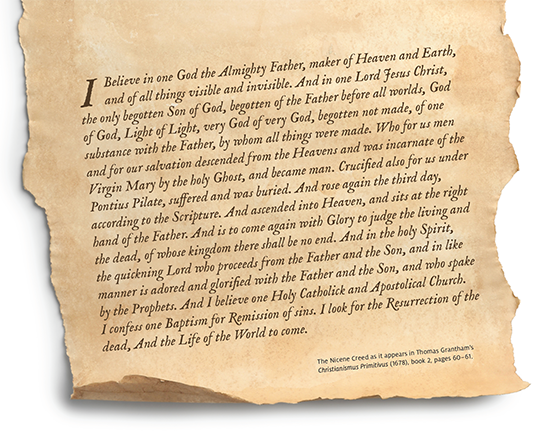
The Orthodox Creed was not the only General Baptist writing to extol the Nicene Creed. The General Baptists’ most popular minister and theologian, Thomas Grantham, had related the importance of the biblically-rooted creeds and the fathers of the ancient church since the early 1660s. In his best known book Christianismus Primitivus (Latin for primitive — early or ancient — Christianity), Grantham said that since “several confessions of faith” had been “published, among which that called the Apostles Creed, and the Nicene, do seem to be of most venerable estimation, both for Antiquity, and the solidity of the matter, and for their excellent brevity, we do hereby declare to the world that we assent to the contents thereof.”
Grantham explained the doctrine in the Apostles’ and Nicene Creeds is “digested and comprehended” in the General Baptists’ own confession of faith written in 1660, which came to be known as the Standard Confession. By printing the Nicene Creed, he wanted everyone to know the General Baptists were “no devisers, or savorers, of novelties or new doctrines.” (Christianismus Primitivus, hereafter “CP,” book 2, chapter 5, pages 59-60).
References to the Nicene Creed and the Council of Nicaea that produced it are all over Grantham’s writings. For example, Grantham appealed to the Council of Nicaea to explain that laypeople should be a part of these gatherings and should have full discussion and voting privileges in church councils (like association meetings today or committees that write doctrinal or other statements) (CP, book 2, chapter 11, page 142).
Grantham also appealed to Nicaea to argue that Baptists (though separated from the Church of England) should have “moderation” toward those from other churches or denominations (CP, book III, chapter 5, page 32). And he used the council as evidence when arguing that elders (pastors) and deacons need to be approved by the entire congregation. (CP, Book 2, chapter 9, page 130; see also CP, book III, chapter 12, page 60; book IV, page 22).
Grantham wrote a little book called St. Paul’s Catechism for “parents…of Christian Families” to catechize their children (teach them using doctrinal questions and answers), “which, by the blessing of God, I have found to be useful in my own family.” In it, after his discussion of the Holy Trinity, Grantham printed the text of the Nicene Creed.
Before the Creed, he said, “That thou mayest know how this great mystery was understood by the Ancient Church,…I will show thee their confession of faith, published by a very great council of the Christians in those days, wherein were 318 pastors of the church, who thus profess their faith.” Then he reprinted the Nicene Creed (St. Paul’s Catechism [London, 1687], pages 24–25).
This prizing of the Nicene Creed continued among the General Baptists. Joseph Hooke, a protégé of Grantham and his friend Francis Stanley, later wrote favorably about Grantham’s Nicene orthodoxy and his inclusion of the Nicene Creed in Christianismus Primitivus. (See his book Creed-Making and Creed-Imposing Considered [London, 1729], page 36.)
All English General Baptist ministers, including Paul Palmer and others in the northern part of the colony of Carolina in the late 1600s and early 1700s, were required to sign the oath required by England of Protestant dissenting ministers indicating their affirmation of the Apostles’ Creed, the Nicene Creed, and the Athanasian Creed.
This oath was referred to in the 1700 session of the General Association of General Baptists, with whom our earliest ancestors in North Carolina were affiliated. (W. T. Whitley, Minutes of the General Assembly of General Baptists, 1700, page 65.)
Always Reforming
Let’s encourage the younger Free Will Baptists interested in the ancient church, the Nicene Creed, and the Nicene orthodoxy it represents to celebrate them, just as our General Baptist forebears did. Let’s be “always reforming” our church according to the Scriptures. And let’s retrieve the ancient, biblically-rooted landmarks of our Christian past as we seek to make disciples and teach them to observe everything Christ taught us in His Word.
About the Writer: Matt Pinson has been president and professor of theology at Welch College for 23 years. He holds a master’s degree from Yale, a doctorate from Vanderbilt, and is author or editor of 12 books, most recently 40 Questions About Arminianism. His book The Free Will Baptists:
A New History will be published by University of Tennessee Press in January.