Christmas. The word conjures sounds, flavors, scents, memories — maybe even visions of sugarplums. We know the true meaning of Christmas: God wrapped Himself in human flesh as the smallest, most helpless of humans. We celebrate His arrival, knowing the rest of the story: His commitment to live among us and, ultimately, die for us. That is the reason we celebrate. Yet, we develop traditions which really have nothing to do with the “Reason for the Season.”
Many people around the world celebrate Christmas without an inkling of the Christ Child’s entry into our story, especially in countries and among people groups where the gospel is unknown or has limited exposure. We asked a handful of missionaries and overseas workers to tell us a little about Christmas in their corner of the world.
Doug Bishop, Japan
Japan has several interesting Christmas traditions. Celebrating a Kentucky Fried Christmas is probably the most interesting for those of us from America. When KFC came to Japan, they did brilliant marketing surrounding Christmas, even before Christmas was a big deal!
Their 1974 slogan “Kurisumasu ni wa Kentakkii!” translates to “Kentucky for Christmas!” or “Kentucky is Christmas!” The idea survived, and though it may not be KFC, many Japanese families celebrate Christmas with fried or rotisserie chicken.
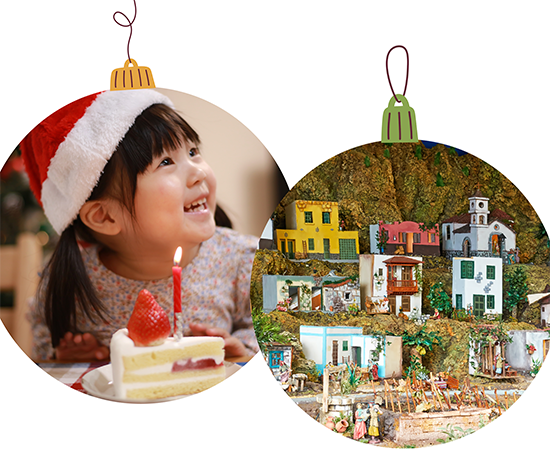
Another popular Japanese Christmas tradition is the Christmas cake. This usually includes white frosting over strawberry shortcake with strawberry decorations. This was also the result of a marketing campaign from
1922 when the Fujiya Confectionery Company encouraged, “Let’s eat cake for Christmas!”
While these are fun and interesting Christmas ideas, the Bishop family usually celebrates Christmas without KFC, since the lines and wait times are long. However, we have been known to “eat cake for Christmas!”
Lea Edgmon, Spain
Do you have a manger scene as part of your Christmas decorations? Here in Spain, the simple nativity is taken to a whole new level. Instead of just a stable with Mary, Joseph, and baby Jesus, Spanish belenes (or “Bethlehems”) often depict the entire town. You might see the innkeeper outside his door, bakers kneading dough, women carrying water, and even Herod’s palace high in the background. These scenes may be miniature or life-sized and are found everywhere — town squares, storefronts, churches, and homes.
In our family, building a belén has become a beloved tradition. Over the years, we’ve added to it little by little — a new house here, shepherds or a donkey there. When our kids were younger, we’d visit the Christmas market to pick out something new for our belén. It became a special part of our holiday rhythm.
At the center of it all, of course, is Jesus. Emmanuel: “God with us.” Not just with kings or priests, but right there among ordinary people going about their day. That’s what I love most about the belén. It reminds us Jesus stepped into real life — busy, messy, everyday life — and transformed it. He still does!
James, Southern France
People in southern France display handmade Nativity figures called “santons.” These include not only the manger characters, but all the townspeople for a little French village. The baker, the mayor, the farmer, etc. Each year they come out with a new figure, and it’s a tradition to get one. I’m trying to follow this tradition, but since I’m starting from scratch, I only have the Christ Child so far. I hope to use my santons to share the Good News of Jesus.
In December, typically on the first Sunday evening, our team leader directs a big Christmas Carol Choir in the largest cathedral downtown. Most songs are in English, which the French love. Local pastors also share the gospel, both in French and in English. Normally, somewhere between 500 and 1,000 people come, sing, and hear the gospel!
I’ve started a personal tradition on Christmas Day. After I’ve gone to my coworkers’ house to eat lunch and exchange gifts, I invite all my friends to my apartment for chili. I like chili because it’s a warm, traditional American meal, which my friends love, and you can make a big pot for a lot of people! Some years, it’s just a few people.
Other times, over 30 people fill the space! However many people show up, I love my Christmas traditions in southern France.
Dana Portell, International Student Ministry
Our annual baking day with international students is a meaningful tradition blending warmth, hospitality, and faith. As we gather in the warm kitchen, laughter fills the air along with the aromas of cinnamon and sugar.
Each student brings a unique story and cultural background, making the experience rich with conversation and connection. While we decorate cookies, we share the Reason for our hope during the Christmas season.
This day filled with baking allows for deeper conversations. Conversations which allow us to share the story of Emmanuel in an authentic and transparent way. A simple day spent baking and eating cookies helps us build a community that transcends cultural borders to reach their hearts with God’s love.
Missionary to Asia, Unnamed — Christmas wasn’t celebrated where I lived in Asia, except in the small handful of fellowships dotting the city. However, the university allowed us to use traditional songs and Christmas stories in the classroom and provided a space for our students to participate in a party, complete with singing carols, playing games, Christmas cookies they helped bake, and a Christmas play.
The carols we sang told the story of the Christ Child, God’s gift to mankind. We taught them in class, made tapes so students could practice, and sang them together at the party. Carols filled the air during December.
Several students met with us to practice their roles in the play. Beginning with Creation and the Fall, it explained why God sent His Son. Angels visited Mary and Joseph, who then made the journey to Bethlehem to hear the innkeeper declare he had no room. Throughout the play, each character wore a black armband to show the death brought by the Fall. But when the Christ Child was born, Mary and Joseph, the innkeeper, and the shepherds removed their black armbands. We ended by singing “Joy to the World” while angels declared the very good news.
For weeks after, students asked questions about the songs, parts of the play, and the armbands, giving us countless opportunities to share the hope and life He brings.
As students graduated, married, and had children, they continued to visit, bringing their children. We baked cookies, trimmed the tree, lit the advent wreath reciting all it represented, and sat on the floor playing with the nativity, telling the story of the birth of little friend Jesus and how much He loves them. Christmas was a wonderful time to share the gospel.
Jesus’ birth embodies the heart of the gospel: “For God so loved the world that he gave his only begotten son….” As we celebrate the most amazing of God’s good gifts, let’s remember to pray for those who may hear the truth of the gospel message for the first time this year. Ask God to use Christmas traditions —both secular and spiritual — to provide opportunities to tell open hearts and listening ears of the greatest Gift.
After all, it’s about the gospel!
Intrigued by Cultural Christmas Traditions?
Some countries’ traditions are informed by their Roman Catholic and Orthodox church history; others have only the secular aspects. Below are traditions in some countries where IM, Inc. has reach through missionaries or partners.
Argentina: The warm streets of Argentine cities often mimic the décor seen in the States: lights, wreaths, Christmas trees, Papá Noel, and Nativity scenes or pesebre. After midnight on Christmas Eve, globos (paper decorations with a light inside, like Chinese lanterns) fill the night sky.
Bangladesh: Even though a hefty majority-Muslim country (85%) with only about 0.3% Christian population, Christmas — known as Borodin, or the Big Day — is a public holiday. Christmas decorations fill public spaces in the cities. Christians often gather for a Christmas Day service.
Brazil: Christmas is a family-oriented holiday with nativities, lights, Papai Noel, Missa do Galo (Rooster Mass, midnight on Christmas Eve), and traditional Brazilian foods. Rio de Janeiro boasts the world’s biggest Christmas tree. At 230 feet tall and with over 900,000 LED lights, it floats in the Rodrigo de Freitas Lagoon.
Bulgaria: Christmas Eve, or Badni Vecher, is marked by fasting throughout the day while preparing for a vegetarian feast with an odd number of dishes that evening. Families gather and share this special meal, hoping it will lead to prosperity in the coming year. Caroling and vibrant church services honor the birth of Christ.
Cuba: Christmas celebrations were banned from 1969 – 1998. Christmas Eve celebrations, or Noche Buena (the Good Night), focus on family gatherings and local cuisine. Christians gather for worship.
Ecuador: La Novena commemorates Mary’s nine-month pregnancy and features nine prayers for each of the nine days before Christmas Eve. On Christmas Eve, parades feature a statue or image of Baby Jesus carried through the streets, often accompanied by other members of the Christmas story.
Germany: Christmas markets sell mulled wine, gingerbread, and handmade ornaments. A pickle ornament is hidden on trees. The first child to find it on Christmas morning receives an extra present.
Ghana: Churches are filled with people dressed in their colorful, ethnic clothes on Christmas Day. Children may put on a nativity play. Ghanaians celebrate Christmas from December 20 through the first week of January.
India: Christmas is not celebrated by the majority of India. In South India, Christians may put small, oil-burning clay lamps on their flat roofs to demonstrate Jesus is the light of the world.
Italy: On January 6, the Befana brings gifts to children for Epiphany, symbolizing the end of the Christmas season and the importance of family and gift-giving. Families eat panettone and torrone.
Ivory Coast: In 1958, the city of Abidjan lit the first official Christmas tree in the world, commemorating their first year of independence from France. A festive and joyous holiday, filled with food, music, and family gatherings, Christmas contains a mix of both traditional and modern elements.
Pakistan: Christmas Day is a public holiday, but in honor of Jinnah, Pakistan's founder, rather than Jesus. Christians still celebrate with processions, gift-giving, carol singing, and in some less-restrictive areas a star on the roof of the house.
Panama: Christmas markets feature handmade crafts and delicious treats. Even as they enter dry season, Panamanians embrace Christmas trees, gift-giving, and caroling through the streets. Many paint their homes or create life-sized, papier-mâché dolls (muñecas) to display outside their homes.
Philippines: Celebrations are the longest in the world, beginning in September. The Giant Lantern Festival features illuminated lanterns that symbolize the star
of Bethlehem.
Russia: For decades following the Communist revolution in 1917, Christmas was banned and only celebrated secretly. Now, it may be celebrated on December 25 or January 7, depending on whether they use the Gregorian or Julian (Orthodox) calendar. Either way, it is likely to be a quieter holiday.
Togo: Christmas Day is a public holiday, viewed as a day for spiritual reflection, celebration of Christ’s birth, and an opportunity to strengthen familial relationships. Family meals, gift-giving, and decorations are common.
Uruguay: Christmas celebrations often begin on December 24 with Las Posadas, a procession commemorating Mary and Joseph’s journey to Bethlehem. Nativity scenes, Christmas trees, and lights decorate homes.
Zimbabwe: Most people attend a church service on Christmas Day. After the service, most of the rest of the day is spent journeying from house to house,
visiting family and friends. They exchange gifts and
eat food at each home.
Learn more about the work of IM, Inc. at www.iminc.org.