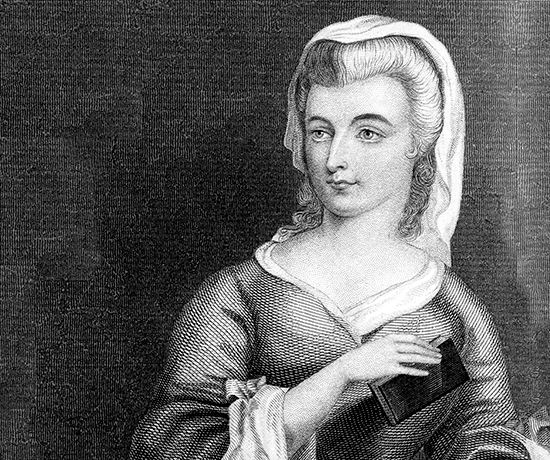
Samuel Wesley, alongside his wife Susanna, ministered in various English villages. Over the years, the couple grieved the loss of four sets of twins and wept over another baby accidentally smothered by their maid. Susanna gave birth to her 19th child in 1709. With little income and so many children, they lived under constant financial strain. Samuel once spent several months in debtor’s prison.
Susanna had a mind of her own. The daughter of a well-known minister who rejected the Church of England, she decided at age 12 her father was wrong. Years later, that independent spirit caused trouble in her marriage. One night, when her husband said the family prayers, he asked for blessings on England’s monarch, William III. Believing him to be a usurper, Susannah refused to say “Amen” to the prayer, explaining, when asked, that her beliefs were a matter of conscience.
She later described her husband’s reaction: “He immediately kneeled down and imprecated the divine Vengeance upon himself and all his posterity if ever he touched me more or came into a bed with me before I had begged God’s pardon and his, for not saying Amen to the prayer for the K(in)g.” Their son John reported his father’s words as, “You and I must part: for if we have two kings, we must have two beds.” After six long months of sleeping apart, the pastor acquiesced.
The couple struggled in other ways. While Samuel was absent from his home and parish for some time, Susanna began reading published sermons and discussing them with her children on Sunday evenings. When neighbors learned of this, they began attending. These weekly gatherings swelled to over 200 people. Some started skipping morning church services. When Samuel heard about this, he complained. Susanna responded in a letter: “In your absence I cannot but look upon every soul you leave under my care as a talent committed to me under a trust by the great Lord of all the families of heaven and earth.” Such disagreements led this pastor’s wife to confess to one of her children: “‘Tis an unhappiness almost peculiar to our family that your father and I seldom think alike.”
In 1725, the Wesleys’ good-looking daughter Mehetabel (1697–1750), whom they called Hetty, ran off with a lawyer. She soon found herself unmarried, abandoned, and pregnant. Samuel, devastated and embarrassed, persuaded a local plumber to marry her. The baby came four months after the wedding.
The Wesleys’ son John, of future Methodist fame, was away studying at Oxford when Hetty eloped. He sent word of his plans to come home. On April 16, 1726, Susanna responded to his letter: “Do not propose to yourself too much satisfaction in coming hither; for what the world calls joy lives not within these walls. But if your heart be right and you can rejoice in God whether you have or have not anything else to rejoice in; if he be the pleasure of your mind, so that you can feel delight in each perception of his presence, though encompassed with (poverty, reproach) and shame, then you may spend a few months in Wroot as happily as in any place of the world.”
About the Columnist: Paul V. Harrison has pastored Madison FWB Church in Madison, Alabama since 2015. Previously, he pastored Cross Timbers FWB church in Nashville, Tennessee, for 22 years. He was an adjunct professor at Welch College for 17 years, teaching church history and Greek. Paul is the creator of Classic Sermon Index, a subscription-based online index of over 66,000 sermons, with clients including Harvard, Baylor, and Vanderbilt, among others: classicsermonindex.com.