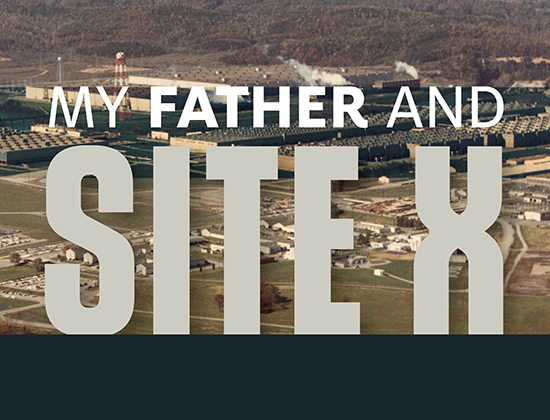
Site X was shrouded in secrecy — government secrecy. Soon after, Site X was called Clinton Engineer Works and six years later, in 1949, first appeared on Tennessee maps as Oak Ridge. Its nickname was Atomic City. By then, most people knew it had been one of three main sites for the Manhattan Project that made the atomic bombs dropped on Hiroshima and Nagasaki in August 1945. Los Alamos, New Mexico, and Hanford, Washington, rounded out the trio.
My father was at Site X for only a few weeks in 1943. The previous fall, General Leslie Groves, director of the Manhattan Project, approved the acquisition of 59,000 acres along the Clinton River, 20 miles west of Knoxville. By spring 1943, construction for Site X began on a clandestine crash schedule. Fenced, with guards and five security gates, it was top secret. By 1945, it had become the fifth largest city in Tennessee with a population of 75,000. Residents had no idea why Site X was there, nor did most workers until after Hiroshima and Nagasaki.
In The Devil Reached Toward the Sky, Garrett Graff relates nuclear engineer Edward S. Bettis’ experience: “I was told absolutely nothing….My interview for the job took place on a fire escape in the old Empire Building in Knoxville.”
When Bettis asked, “What will I be doing?” The man who hired him said, “We won’t tell you. Ever.”
Early on, Site X had no sidewalks, no pavement, only memorable mud. One day Karl Z. Morgan heard a “plaintive call from a young lady,” stuck in the mud to the top of her work boots, unable to move. “Some of us got her out, but her boots are still there…buried under the highway, I guess.”
Within months, Site X became home to enormous nuclear plants: K-25, Y-12, S-50, and X-10, along with 300 miles of paved roads, water and sewer plants, thousands of houses and dorm rooms, schools, trailers, bath houses, cafeterias, grocery stores, churches, a jail, a steam power plant, telephone service, and 55 miles of L&N and Southern Railroads. By 1945, Site X used more electricity than New York City.
Of course, my father, Guy Hampton, who was there in June and July 1943 also had no clue. He had taken a carpentry correspondence course and was employed by DuPont in 1934, at age 24. He continued with them off and on through mid-1943 in three states: Tennessee, Indiana, and Alabama. When I was growing up, he simply called those Dupont construction jobs “defense work.”
From its founding in 1802, Dupont was best known for producing war material. Later, they invented and developed many other products, including nylon. The X-10 complex at Oak Ridge and the Hanford complex DuPont began building in late 1943 were for extraction of plutonium, which eventually led to the Fat Man Atomic Bomb dropped on Nagasaki, August 9, 1945. K-25, Y-12, and S-50 at Oak Ridge produced uranium for Little Boy, the bomb dropped on Hiroshima, August 6, 1945.
Last August, as the 70th anniversary of the bombings of Hiroshima and Nagasaki approached, memories about my father and Site X surged back full force. For about a month, Guy did carpentry work for DuPont somewhere on the X-10 plutonium complex that eventually occupied 112 acres at Site X. The X-10 complex included research labs, waste storage, training facilities, administrative area, laundry, cafeteria, first aid center, and fire station. More importantly for the Manhattan Project, by early 1944, X-10 had fulfilled its purpose to convert uranium-238 into tiny amounts of plutonium-239. After that, fuller production of plutonium moved to Hanford, Washington.
Sometime in June 1943, my family and I moved to the area. I don’t know where we lived, perhaps inside the fenced and guarded gates of Site X, perhaps not. As I grew older, I learned the story of my father’s brief “defense work” at Site X. Sometime in July, Guy collapsed to his knees at work.
For weeks, he had suffered from excruciating headaches and occasional double vision. That day was the worst ever. He crumpled and could not rise. A fellow carpenter drove him home. Doctors at a Knoxville hospital suspected a neurological problem and urged him to see Dr. Cobb Pilcher, a renowned neurosurgeon at Vanderbilt Hospital in Nashville.
Guy was transported by ambulance to Nashville, and on July 22, 1943, Dr. Pilcher diagnosed the problem: an orange-sized tumor in the right back quadrant of Guy’s brain. Surgery and pathology followed. The tumor was malignant. The bad news? You didn’t survive brain tumors in 1943, much less malignant ones. The good news? According to the Nashville Tennessean newspaper, Dr. Pilcher was a world-renowned neurosurgeon. Radiation began, along with a long recuperation. It was a year, Mother said, before Guy could work again, yet he lived 37 more. A true miracle!
But while Guy’s brain tumor was horrible, the war and the bombs were even more horrible. When Adolph Hitler committed suicide in April 1945, my parents did not mourn. In May 1945, when the war in Europe ended, and in August when the war in Japan ended, they were jubilant, along with the rest of the nation.
So, what about Guy Hampton after the war? As if that miracle of survival and recuperation from a malignant brain tumor were not enough, my father soon came to the Lord in faith, repentance, baptism, and became a member of Rock Springs Free Will Baptist Church in Charlotte, Tennessee. He served as the song leader and a deacon until shortly before his death in 1980 by a second brain tumor.
God gifted my father with two kinds of life, physical and spiritual. Physically, after the brain tumor, the additional 37 years. Spiritually, an everlasting new-creation life. I was gifted, too, because as I grew from infancy to womanhood, Guy Hampton, my good father, modeled many Christian virtues. I am so grateful.
Guy liked to laugh, and he did — a lot. He often used the word jolly to describe friends and acquaintances who were happy and cheerful. People whom he was glad to be around, and I’m sure were glad to be around him because he was also jolly. Gloomy, miserable complainers were not on his jolly-list.
Speaking of songs, music was in Guy’s bones. In his youth, my paternal grandmother’s diary often noted, “Guy went to the dance tonight.” After salvation, he sang in trios, quartets, and led music at church. When I was ten, he bought my sister Grace and me a piano after selling a white-faced heifer. He also paid for lessons. After supper, we sang. I played the tall, black piano and took soprano, Grace carried a beautiful alto, and Guy sang tenor from our worn, soft-back song books.
He practiced Paul’s commands in Ephesians 5:19 to sing and make melody in our hearts. When I was 11, our church pianist moved away. He “nominated” me. The church agreed.
Loyal friendship was high on Guy’s list. He testified as a character witness for a neighbor accused of murdering his wife. The man was acquitted. He spent many hours of the night talking an alcoholic friend into soberness. He helped build homes for two families shunned by the community because of their race. For days, weeks, over many years, he took in Shine, a transient who appeared unannounced, and later disappeared unannounced.
Guy was wise in judgment, able to see two sides. “That’s six of one and half a dozen of the other,” he often said. He paid attention to Jesus’ warning about specks and planks in Matthew 7. He went to funerals, spoke up, carried the heavy end of the log, didn’t yarn (lie), visited long after church ended, tended to widows, gave and didn’t take, helped and didn’t hurt. Guy Hampton — my Christian father, my model.